
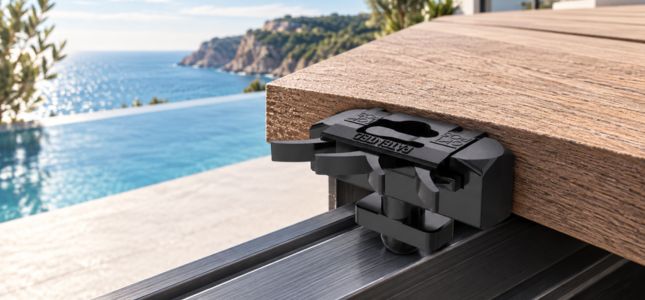
When an architecture team or a contract technician sources outdoor decking for a demanding project, the fixing system is rarely the first question asked and often the one that determines the outcome. It decides whether the surface reads as continuous, how the assembly behaves under load, and whether a damaged board in year eight becomes a morning’s work or a fortnight’s disruption.
The market divides roughly in two: manufacturers who specify a board and buy in a generic clip, and manufacturers who develop and register their own. This guide sets out what separates the two, what patented decking fixing systems actually prove, and what documentation to request before the specification is closed.
What a hidden fixing decking system does beyond hiding the screw
A hidden fixing decking system anchors the board to the substructure through clips seated between pieces, with nothing visible on the walking surface. The aesthetic argument is obvious and, in architecture and landscape work, sufficient on its own.
The technical argument is less visible and matters more over time. A well-designed clip distributes stress more evenly than a face-fixed screw, allows the board the movement it needs under thermal and moisture change instead of restraining it, and closes off the entry points where water and dirt begin the process of degradation. On rooftop decks, horizontal facades, coastal sites and heavily trafficked areas, the fixing is what determines how long the assembly holds together.
Which is why evaluating a supplier on the board alone leaves out half the system.
What does a registered patent actually prove?
Less than most specification documents assume, and more than nothing.
A registered patent proves that a technical solution was original at the date of filing, that it belongs to a named holder, and that it exists as a public document anyone can consult. That last point is the useful one for a specifier: a patent is verifiable by a third party, which almost nothing else in a product brochure is. The European Patent Office’s Espacenet database database holds over 100 million patent documents and is free to search, so a claim of proprietary technology can be checked rather than taken on trust.
What a patent does not prove is performance. A registration certificate says a design is new. It says nothing about how that design behaves with a deck on top of it in year fifteen.
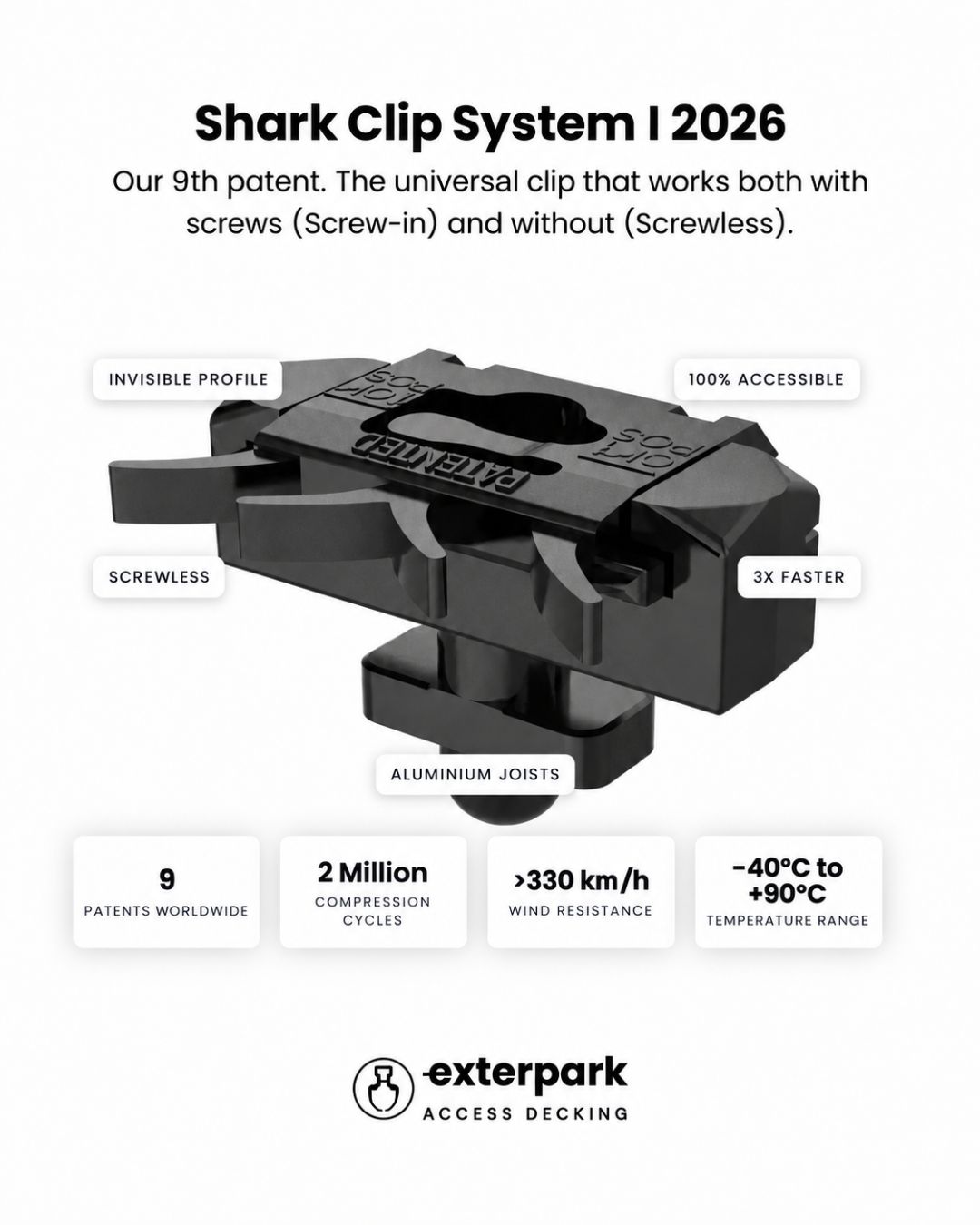
The second thing a patent history indicates is continuity. A manufacturer registering fixing patents since the nineties has been through several generations of correction, adaptation to new board materials and response to changing standards. Exterpark registered its first concealed fixing clip, Exterpark Classic, in 1995, and has since accumulated nine patents in fixing technology, the most recent being the Shark clip. That is a development record rather than a marketing claim, and it is checkable.
What laboratory testing adds that a patent cannot
Testing is where performance gets established. External laboratories assess mechanical resistance, behaviour under wind load, stability across thermal cycles and retention under tensile stress, and they issue documentation that can enter a tender file.
Exterpark’s fixing systems have been assessed by three separate bodies: AIDIMME, Tecnalia and Applus. According to data declared by the company itself, the systems offer wind resistance exceeding 330 km/h, a figure that becomes relevant on exposed rooftops, on horizontal facades and in coastal installations where uplift rather than wear governs the design.
Both types of evidence are needed, and they answer different questions:
A supplier who can produce one but not the other has answered half the question.
How the fixing system maps onto the range
Compatibility across a range matters more than it appears, because a project rarely uses a single format. The six collections of the Tech composite line, ONE, CUBE, SUPREME, NEXUS, REAL and YNOVA, all work with the Shark clip, so a scheme combining finishes within that line keeps one fixing detail throughout. The Wood line uses a separate concealed fixing, Magnet S, engineered around the movement and tolerances of natural timber. Shark remains the current system across the composite range.
The practical consequence for a specification team is that board, fixing system and technical documentation arrive from one source. Fewer interfaces means fewer of the gaps where responsibility gets lost between suppliers when something needs resolving on site.
Documented references include Marsa Al Arab and Bvlgari Ocean Mansions, both coastal luxury hospitality schemes where the fixing was specified under conditions of sustained exposure.
Four checks before you commit to a supplier
Proprietary registration, with dates. Ask for the registration references and check them yourself. Continuity over time tells you more than the count.
Documentation available at specification stage, not after order. Technical data sheets and laboratory certificates should arrive when you are writing the specification, not when the material is being delivered.
Compatibility across the whole range. A clip that works with three collections out of six creates a detailing problem the moment the project mixes formats.
References at a comparable level. A system proven on a domestic terrace is not evidence for a hotel roof deck.
Exterpark was a finalist in the Best of IBS Awards 2026, which is a useful indicator but not a substitute for any of the four checks above.
Frequently asked questions about patented decking fixing systems
How can I verify a manufacturer’s patent claim independently?
Ask for the registration references and search them in a public patent database such as Espacenet. A claim that cannot be traced to a registration document should be treated as a marketing statement rather than a technical one.
Does a patented fixing system guarantee better performance?
No. A patent establishes originality, not performance. Performance is established by laboratory testing, and the two are separate pieces of evidence that should both be requested.
Does specifying a proprietary clip tie the project to one supplier?
To an extent, yes, and that is the honest trade-off. A proprietary system means replacement clips come from one source. What mitigates it is range compatibility and a manufacturer with a long enough production record to make continuity of supply a reasonable assumption.
What documentation should I request before closing the specification?
Product data sheets, laboratory test certificates from named bodies, patent registration references, and installation detailing for the substructure the project uses.
What is the practical difference between a generic clip and a patented one?
A generic clip can change supplier, geometry or material between production runs with no obligation to tell the specifier. A registered system corresponds to a fixed, documented design attached to a named holder, which is what makes a chain of responsibility possible.
Request the documentation for your specification
Architecture, landscape and contract teams working on projects that require decking installation without visible screws can request the full technical file from Exterpark’s specification team (enlace interno): data sheets, laboratory certificates and patent references, available from the specification phase rather than after the order.